Hospitalization or Medical Emergency Abroad: Complete Emergency Guide
Description
You are sick or injured and you are far from home. Maybe it came on suddenly, maybe you have been waiting to see if it gets better, and it has not. Either way, you are now facing a medical system you do not know, in a country where you may not speak the language, trying to make decisions that matter for your health or even life, while your brain is running on fear. This guide is what you hold onto if that is where you are.
🏥 The "Hospitalization or Medical Emergency Abroad: Complete Emergency Guide" comes with a printable Emergency Card covering your blood type, allergies, current medications with dosages, insurance details, and key contacts, filled in before you travel. If something happens to you, your partner uses it. If something happens to your partner, you use it. If you are alone, it speaks for you in case you cannot.
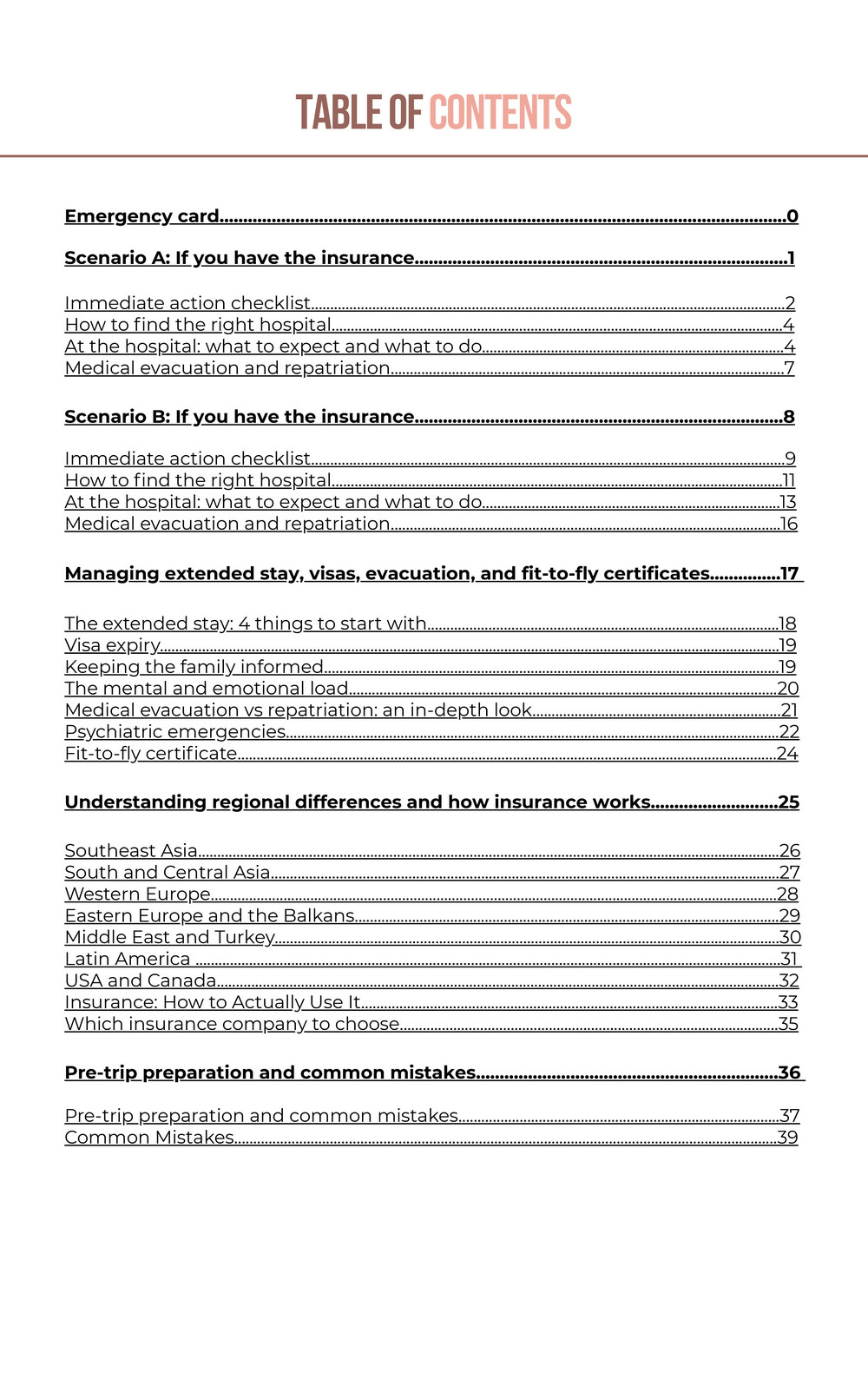
📖 This is our longest guide, running to 45 pages. It has two separate sections that cover two complete scenarios: one for if you have travel insurance and one for if you do not, because the path through this crisis is entirely different depending on which situation you are in. Each scenario walks through the immediate action checklist:
- how to find the right hospital in a foreign country
- what to expect once you are there
- how to navigate it
- when and how to handle medical evacuation.
⚠️ It also addresses what most people do not know until they find themselves in the situation: the difference between evacuation and repatriation, what actually warrants each one, and what happens if you make that call wrong in either direction.
For situations that go beyond a few days, the guide walks through extended stay management:
- how to resolve your visa situation when hospitalization drags on longer than expected
- how to handle logistics while someone you are traveling with is in a hospital bed
- how to get a fit-to-fly certificate before discharge so you are not finding out at the airport that you needed one.
🌎 The guide also includes a regional overview detailing what to expect from medical systems across Southeast Asia, Western Europe, Eastern Europe, Latin America, South and Central Asia, the Middle East, and North America, and a dedicated section on how to actually use travel insurance in practice, including the decisions and documentation that determine whether your claim goes through.
The common mistakes section talks about what cost people the most: waiting too long to seek help because hospitals feel intimidating in a foreign country and you keep hoping it will pass, and going to the wrong type of hospital first, which in many countries means ending up somewhere that cannot treat you properly. The guide walks through several others that are less obvious but just as consequential.
✈️ The pre-trip section addresses insurance selection, what to read in your policy before you need it, and the destinations where an uninsured emergency may not just ruin a trip but follow you home as debt. It also covers what most travelers skip entirely: the specific questions to ask your insurer before you leave, what your policy actually says about evacuation and air ambulance, and which countries are the most financially devastating if you happen to fall seriously sick there.
Getting seriously ill abroad is already hard enough. Not knowing what to do makes it harder in ways that are entirely avoidable. This is one of the most comprehensive guides on the topic that you can find based on the experience of real travelers.